Can a Blockchain Actually Handle a Stock Market? Robinhood Chain's First Month Says Yes
If you look at the real-world asset (RWA) market today, the top-level numbers are staggering: $37.29 Billion in distributed value and over 1.5 million holders.
but tokenized stocks make up just $2.2 billion of that total, yet they account for nearly 1 million of those holders. Comparing these market caps isn't an the best metric as the rest of the RWA sector is dominated by heavy institutional deposits in T-bills and private credit. The difference in value makes complete sense once we dive into the data.
Now, Robinhood is trying to blow this sector wide open. They quietly launched Robinhood Chain (an Arbitrum L2) to bring assets like Apple, Tesla, and Nvidia on-chain. Here is why it might actually work this time.
How Robinhood Fixed onchain stocks
Previous attempts at tokenizing stocks failed because corporate actions are a nightmare on a blockchain. If Apple pays a cash dividend, airdropping USDC to thousands of Web3 wallets costs a alot in gas fees.
Robinhood solved this using a Dynamic Multiplier ERC-8056
When you hold a Robinhood $AAPL token and a dividend is paid, the custodian reinvests that cash into more Apple stock off-chain. On-chain, your smart contract multiplier simply ticks up from 1.0 to 1.05.
Your wallet still shows 1 token, but it now represents 1.05 shares of Apple. No gas fees, no airdrops. Just a token that automatically compounds in value.
Inside Robinhood’s On-Chain Microstructure
Before we begin, it's important to note that 9 of the most-traded assets we tracked are not all tokenized stocks. TSLA, NVDA, AAPL, MSFT, AMZN, GOOGL, META, SPY, QQQ
To see if this is actually gaining traction, I built a custom Dune dashboard tracking Robinhood Chain’s real-time tokenised stocks metrics.
The data proves users aren’t just buying and holding these stocks they are aggressively trading them. Here is what the on-chain microstructure reveals:
1. The USDG Liquidity Engine:
Robinhood is using USDG as the native stablecoin routing pair for these stocks. Right now, USDG has a total supply of $327.7 Million on the chain, but it is pushing over $1 billion in 24 hour volume. That immense asset velocity implies massive, continuous capital rotation rather than stagnant TVL.
2. Active DEX Trading (Stock ↔ USDG):
Users are actively swapping in and out of the 9 supported assets (including $TSLA,$NVDA, $QQQ, and$SPY) directly on-chain. The daily transaction charts show aggressive DEX activity, with trade counts spiking into the tens of thousands per day. This proves the capital is being actively traded against stablecoins, not just sitting in cold storage.

3. Rapid Holder Growth:
The adoption curve is steadily steepening. Throughout the last month, the unique holder count for these tokenized stocks climbed aggressively, pushing past 10,000 unique wallets interacting with the assets, and now thier decrease a little bit

4. The 24/7 Arbitrage Premium
Traditional stock exchanges operate on rigid schedules (9:30 AM – 4:00 PM EST). On-chain stocks break this model entirely:
The After-Hours Split: Exactly 26.4% of all stocks trades occur during after-hours and weekends, while 73.0% occurs during standard market hours.
Over a quarter of total trading volume is capturing off-hours price discovery, earnings announcements, and global macro news. This highlights a clear structural advantage over traditional brokerages for traders outside the US time zones.

5. Who is Actually Trading
That massive discrepancy how a $2.2 billion market cap commands nearly as many users as the rest of the $37.29 billion RWA market combined comes down to asset velocity.
T-Bills and private credit are institutional, buy-and-hold assets. Capital is parked there to earn passive yield. The Total Value Locked (TVL) is massive, but the actual on-chain turnover is low. Tokenized stocks on Robinhood Chain operate on the exact opposite model. The capital isn’t sitting idle, it is aggressively circulating, with turnover rates reaching between 7x and 20x across these assets. and that why the 1 million user is fair enough for tokenized stocks.
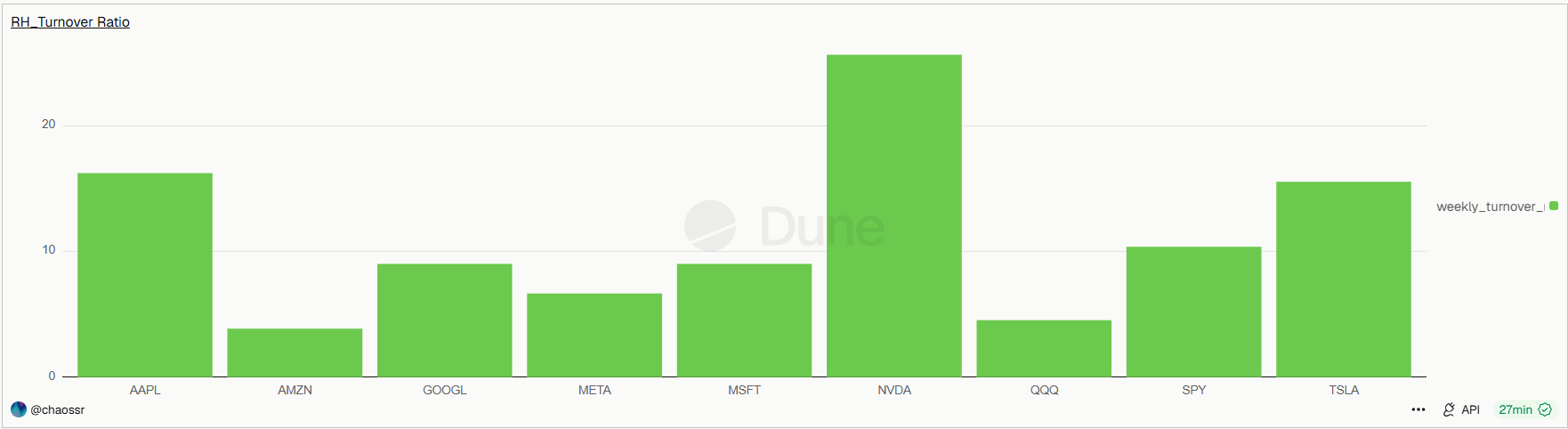
Now to understand who is driving this velocity and why the holder count is fast approaching 1 million, we have to look at the exact trade sizes happening on-chain.
According to the latest swaps breakdown, the volume distribution paints a perfect picture of a healthy market structure:
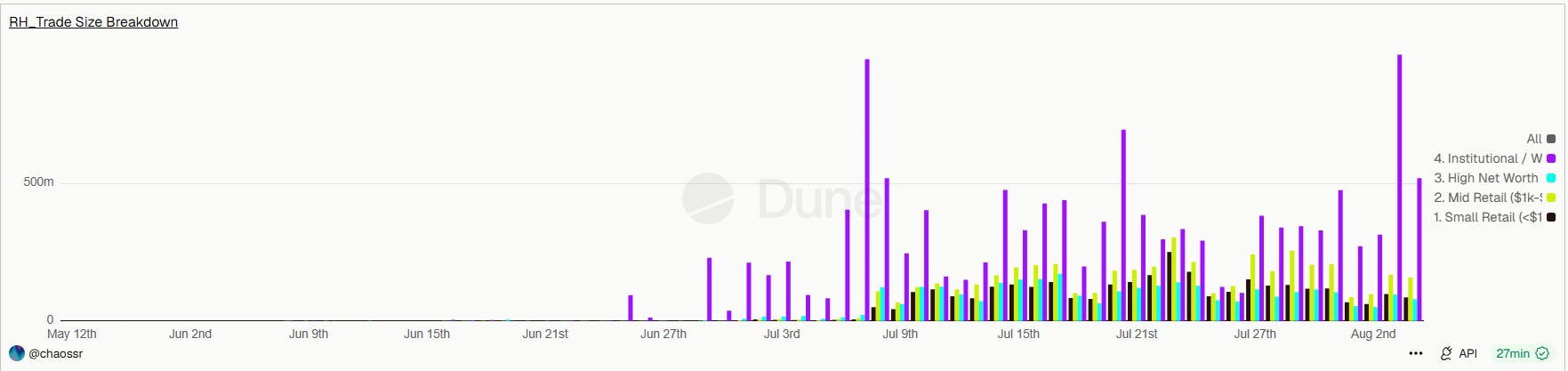
Institutional (>$50k): $520,567,628
Mid Retail ($1k–$10k): $158,515,771
Small Retail (<$1k): $85,612,020
High Net Worth ($10k–$50k): $79,257,158
This specific data tells the complete story. Institutions and whales are providing the deep liquidity backbone moving over half a billion dollars to ensure tighter spreads and market efficiency.
However, the sheer explosion in unique holders is being driven entirely by retail. With over $244 million in volume flowing purely through trades under $10k, this proves that tokenized stocks aren’t just an institutional playground. By combining institutional-grade liquidity with retail-driven velocity, tokenized stocks have quietly become the most active sector in the entire RWA supercycle.
If Robinhood successfully bridges Web2 retail liquidity with Web3 composability, tokenized stocks will easily become the next multi-billion dollar pillar of the RWA supercycle, so next well see the usecases of those stocks on defi.
Data sourced from Rwa.xyz and my own on-chain dashboard, robinhood-tokenized-stocks-analytics. Snapshot: 4 aout , 2026 UTC.
On-chain data are live and may have shifted by the time you’re reading this, check the dashboard for current numbers.